
General Ultrasound
Doppler Ultrasound
Measures how blood is actually moving through your arteries and veins, rather than simply showing their shape. Carotid, peripheral arterial and renal studies, all without radiation, injection or dye.
- Duration
- 30–45 minutes
- Price
- €180, report included
About this scan
What this scan involves
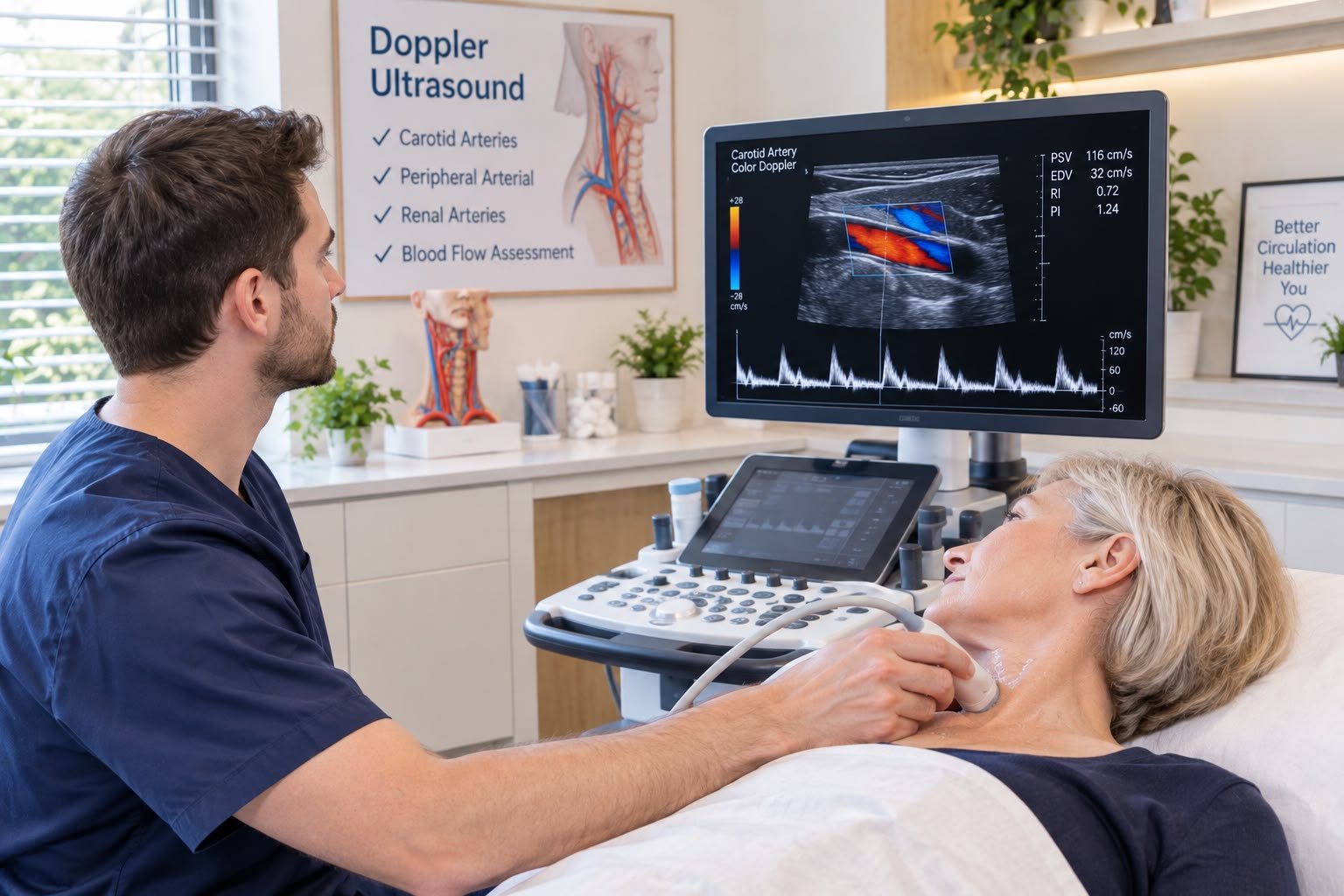
Doppler ultrasound detects the change in pitch of sound reflected off moving blood cells, the same effect that makes a passing siren drop in tone. From that, the equipment calculates the speed and direction of flow at any point, and displays it as colour on the image and as a waveform.
Flow tells you what a picture alone cannot
A narrowed artery forces blood through a smaller opening, so it speeds up. Measuring that speed lets the radiologist estimate how tight a narrowing is, not just note that one exists. The shape of the waveform downstream says something too: a dampened, delayed waveform indicates a significant blockage further up, even when the narrowing itself is out of view.
Carotid studies
The carotid arteries in the neck supply the brain, and narrowing there is a risk factor for stroke. A carotid Doppler measures the degree of narrowing and describes the plaque causing it. It is commonly requested after a transient ischaemic attack, or where a bruit has been heard in the neck.
Arterial studies in the legs
Pain in the calf on walking that eases with rest is the classic sign of arterial narrowing in the leg. Doppler maps where the narrowing is and how severe it is, which is what a vascular surgeon needs before deciding between medical management and intervention.
What we check
Looked at during the scan
- Direction and speed of blood flow at each point examined
- Narrowing, and an estimate of its severity
- Plaque: extent and character
- Waveform shape, showing the effect of disease upstream
- The vessel wall and the size of the lumen
- Comparison with the other side
What's included
€180, nothing added at reception
- A thirty to forty-five minute examination with an accredited sonographer or consultant
- A written report by a consultant radiologist, with velocity measurements
- The report to your GP or consultant within three working days, with your consent
- Urgent findings telephoned to you and your GP on the day
The price you are quoted is the price you pay. No separate reporting fee, no consultation surcharge.
Why people book it
You might choose this scan if
- Carotid artery assessment
- Poor circulation in the legs
- Suspected arterial narrowing
- Follow-up of a known vascular problem
What to expect
Before, during and after
Before your scan
No preparation is needed for carotid or limb studies: eat and take medication as normal. For a renal artery study, we will ask you to fast for six hours, because bowel gas obscures the renal arteries, so tell us which study you need when you book. Wear clothing that allows the neck or the limb to be exposed.
During the scan
You lie on the couch, and warm gel is applied over the vessels being examined. You will hear a loud pulsing or whooshing sound: that is the blood flow being sampled, and it is entirely normal. The sonographer works along each vessel taking measurements, which is what makes this a longer examination than most. It is painless. Allow thirty to forty-five minutes.
After your scan
No after-effects, and you can drive yourself home. The written consultant report follows, typically within three working days, and goes to your GP or consultant with your consent.
How to prepare
No preparation required. Please wear clothing that allows the limb or neck to be exposed.
Book your Doppler Ultrasound
€180 including the consultant report, 30–45 minutes. Choose a time online, or send an enquiry and we will call you back, usually within one working day. If you need to reschedule, please let us know as early as you can.
Questions
Frequently asked
Do I need a GP referral?
You can refer yourself, but for vascular studies a referral is genuinely useful: knowing which vessels are in question and why lets us plan the right examination and the right length of appointment.
Does it involve an injection or dye?
No. Doppler is ordinary ultrasound analysed differently. There is no contrast, no radiation and no needle, which is why it is safe to repeat and safe with impaired kidney function.
Why is it so loud?
The sound you hear is the flow signal itself, converted to audio. Experienced sonographers listen as well as look; an abnormal flow often sounds wrong before it looks wrong.
Should I stop my blood pressure or blood thinning medication?
No. Take everything as normal. Stopping medication before a scan is neither necessary nor safe.
Can you scan both legs, or both sides of my neck?
Yes, and comparison with the other side is a standard part of the examination. Tell us the full question when you book so enough time is allowed.
Also consider
Other general ultrasound scans
20 minutes
Renal & Urinary Tract Ultrasound
Examines both kidneys, the ureters where visible, and the bladder before and after voiding.
€140 · 20 minutes
25–30 minutes
Musculoskeletal (MSK) Ultrasound
Dynamic assessment of tendons, muscles, ligaments, bursae and joints, examined in movement, which is something a static scan cannot show.
€160 · 25–30 minutes
30–45 minutes
DVT / Venous Doppler
A focused examination of the deep and superficial veins of the leg, looking for clot and assessing valve function.
€180 · 30–45 minutes