
General Ultrasound
DVT / Venous Doppler
A focused examination of the deep and superficial veins of the leg, looking for clot and assessing how well the valves are working. The standard test for suspected DVT, and for varicose veins before treatment.
- Duration
- 30–45 minutes
- Price
- €180, report included
Before you book
If you think you may have a DVT right now, with a painful, swollen or hot calf, contact your GP or an emergency department today rather than waiting for an appointment here. A clot needs assessing and treating the same day, and the danger is that part of it travels to the lungs. If you are also breathless or have chest pain, call 112 or 999.
About this scan
What this scan involves
A venous Doppler examines the veins of the leg along their length. The key manoeuvre is simple: a normal vein flattens completely under gentle probe pressure, while a vein containing clot does not. That single observation, repeated along the leg, is what makes the test reliable.
Why a DVT is taken so seriously
A clot in a deep vein can break off and travel to the lungs, which is a pulmonary embolism and can be life-threatening. That is why suspected DVT is a same-day matter, handled through your GP or an emergency department, where a scan and treatment can happen together within hours.
The other reason people come: varicose veins
Where the question is varicose veins rather than clot, the examination is different in emphasis. The valves that stop blood falling back down the leg are tested by squeezing the calf and watching whether flow reverses. Mapping which veins are incompetent, and where, is exactly what a vascular surgeon needs before planning treatment.
What a normal scan does and does not rule out
A normal scan of the leg veins makes a DVT in that leg very unlikely at the time of scanning. It does not exclude a clot elsewhere, and it is not a guarantee for the following weeks. If symptoms change or worsen after a normal scan, seek medical advice again rather than assuming the scan settled it.
What we check
Looked at during the scan
- Compressibility of the deep veins along the leg
- Clot: presence, extent and whether it appears recent or old
- The superficial veins, for superficial thrombophlebitis
- Valve function, tested with calf compression
- Direction of flow, and any reflux
- A Baker's cyst or other cause that can mimic a DVT
What's included
€180, nothing added at reception
- A thirty to forty-five minute examination with an accredited sonographer or consultant
- A written report by a consultant radiologist
- Urgent findings telephoned to you and your GP on the day, without exception
- The report to your GP or consultant within three working days, with your consent
The price you are quoted is the price you pay. No separate reporting fee, no consultation surcharge.
Why people book it
You might choose this scan if
- Suspected deep vein thrombosis
- Painful or swollen calf
- Varicose veins
- Leg swelling after surgery or travel
What to expect
Before, during and after
Before your scan
No preparation is needed. Eat and take medication as normal, including any blood thinner. Wear clothing that allows the whole leg to be exposed, or expect to change into a gown; shorts are ideal.
During the scan
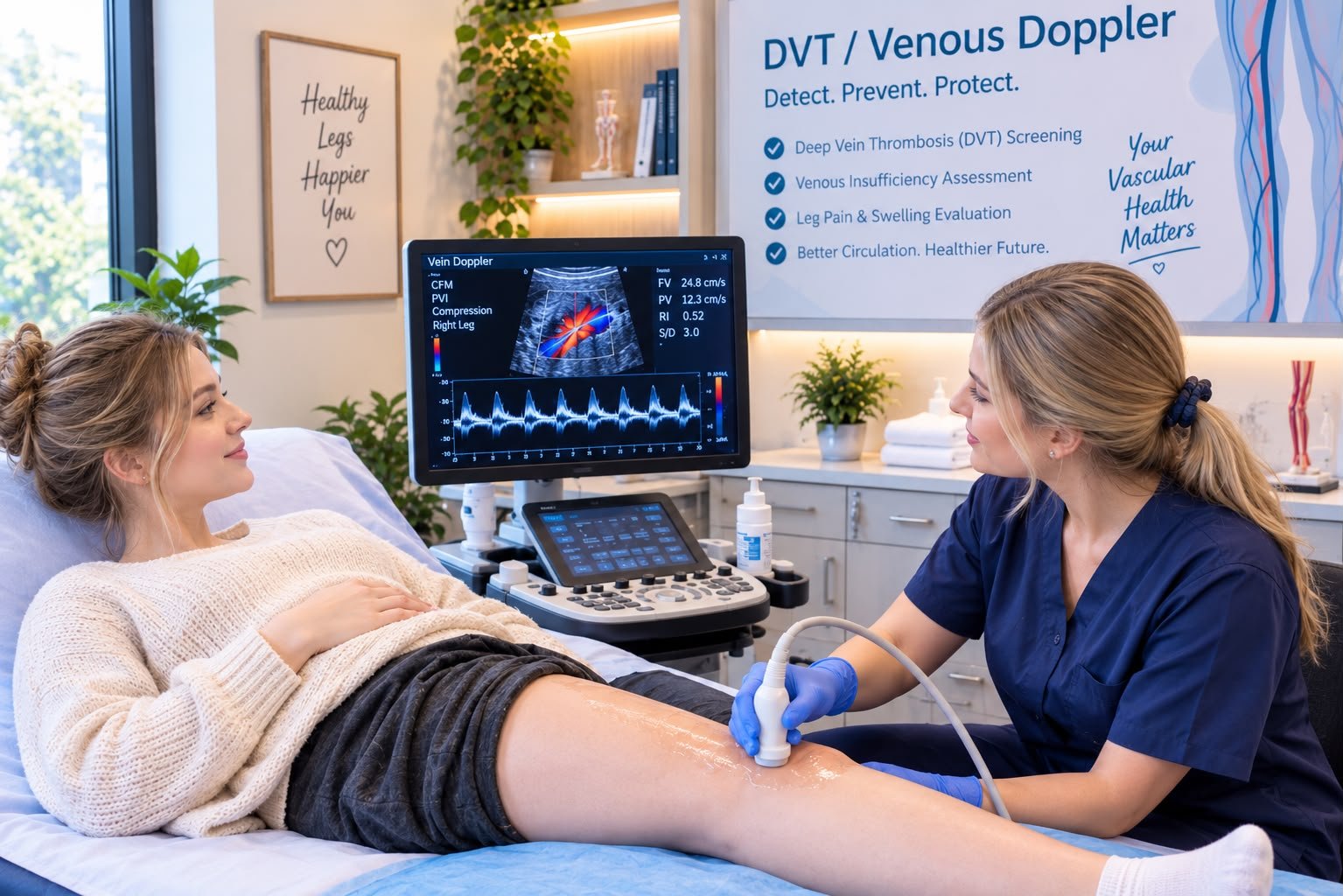
You lie on the couch, usually with the head end raised so the veins fill. The sonographer works down the leg from the groin with warm gel, pressing firmly at intervals to test whether each vein compresses. The pressure is deliberate and can be uncomfortable over a tender calf. For valve assessment, your calf is squeezed while flow is watched, and part of the examination may be done standing. Allow thirty to forty-five minutes.
After your scan
No after-effects. If a clot is found, we telephone you and your GP the same day and tell you exactly where to go; you will not be sent home to wait for a letter. Otherwise the written consultant report follows within three working days.
How to prepare
No preparation required. Please wear clothing that allows the whole leg to be exposed. If you have a suspected DVT, contact your GP or an emergency department as well as booking with us, because a clot needs treating urgently.
Book your DVT / Venous Doppler
€180 including the consultant report, 30–45 minutes. Choose a time online, or send an enquiry and we will call you back, usually within one working day. If you need to reschedule, please let us know as early as you can.
Questions
Frequently asked
I think I have a DVT today. Can you scan me?
Contact your GP or an emergency department today instead. Suspected DVT needs same-day assessment and treatment in one place. Book with us for a planned study, not an acute one.
What happens if you find a clot?
We telephone you and your GP the same day and direct you to immediate care. A clot is never left to a posted report.
Do I need a GP referral?
No, but for a planned venous study a referral describing the question helps, particularly if the issue is varicose veins ahead of treatment.
Does it hurt?
The compression is firm by design, and over an already painful calf it can be uncomfortable. Tell the sonographer, who will work as gently as the test allows.
Should I stop my blood thinner first?
No. Continue all medication as normal, and tell the sonographer you are taking it.
Also consider
Other general ultrasound scans
15 minutes
Soft Tissue Ultrasound (Lump & Bump)
Characterises lumps and swellings anywhere in the superficial soft tissues.
€145 · 15 minutes
25–30 minutes
Musculoskeletal (MSK) Ultrasound
Dynamic assessment of tendons, muscles, ligaments, bursae and joints, examined in movement, which is something a static scan cannot show.
€160 · 25–30 minutes
30–45 minutes
Doppler Ultrasound
Measures blood flow through arteries and veins, including carotid, peripheral arterial and renal studies.
€180 · 30–45 minutes